

China Breaks Ground in Satellite-Ground Laser Communication
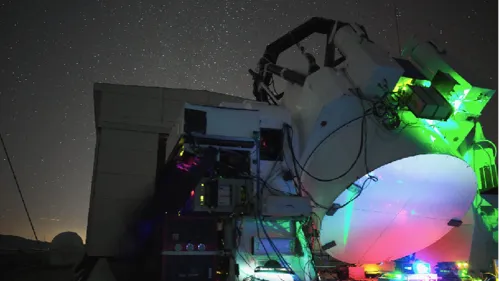
Chinese researchers have achieved a remarkable milestone in satellite-ground laser communication, successfully demonstrating two-way data transmission at a speed of 1 gigabit per second over a distance of more than 40,000 kilometers, according to the China Science Daily.
This groundbreaking experiment conducted by Chinese research institutions showcases advancements in satellite-ground laser communication, which is pivoting in two primary directions: optimizing peak downlink speeds to meet increasing data demands and enhancing long-duration, stable communication capabilities in high-orbit environments.
The initiative involved the collaborative efforts of the Chinese Academy of Sciences' Institute of Optics and Electronics, Beijing University of Posts and Telecommunications, and the China Academy of Space Technology, establishing a stable laser link between a ground observatory located in Yunnan Province and a geosynchronous satellite.
During the experiment, links were successfully established over an impressive distance of up to 40,740 kilometers, achieving two-way communication capabilities for both uplink and downlink at a high speed of 1 gigabit per second. The team set notable records, including a rapid link establishment time of just four seconds and maintaining the link for over three continuous hours.
Conducting this experiment on a high-orbit platform marked a significant advancement, extending the stable communication duration from mere minutes to hours and ensuring high-speed, real-time two-way communication capabilities. This achievement is considered a pivotal step towards the development of an integrated Earth-space network.
The implications of this breakthrough extend beyond simple data transmission. It enables satellites to receive complex commands in real-time, transitioning high-orbit satellites from basic data relay stations into sophisticated intelligent processing hubs.
Researchers highlighted that this successful experiment also validated the deep-space communication capabilities of ground stations, thus paving the way for future high-speed laser communications with celestial bodies such as the Moon and Mars, as well as with distant space probes.
The reliability demonstrated during the experiments suggests that the technologies involved are mature enough to serve as a foundation for large-scale applications in the future, indicating significant prospects in the domain of satellite communication and beyond.
Read These Next

The Threat of AI Deepfakes in Politics
The article explores the rising concern of overseas content farms using AI to generate misleading political deepfakes, highlighting their mechanisms, implications for democracy, and the need for improved detection methods.

Grammarly's AI Sparks Ethical Debate on Consent
Exploring the ethical implications of Grammarly’s AI feature that mimicked well-known writers, highlighting consent and the quality of AI outputs in creative fields.

Inside China's Weight Management Struggles in Major Hospitals
China's Healthy China 2030 Initiative prioritizes weight management, with hospitals offering services to tackle obesity and improve health.