

Chinese Team Introduces Smart Firewall Electrolyte for Battery Safety
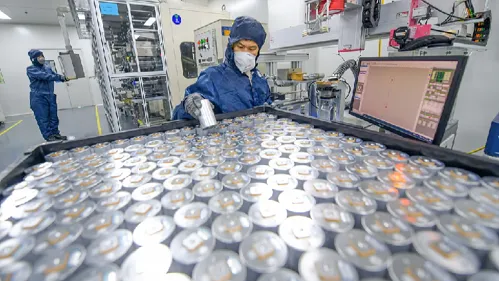
A research team from the Institute of Physics at the Chinese Academy of Sciences has made a significant advancement in battery safety by developing a self-protecting, non-flammable electrolyte designed for sodium-ion batteries. This innovative solution effectively prevents the phenomenon known as 'thermal runaway,' marking a pivotal moment in enhancing safety standards for high-capacity battery cells.
The newly created technology, referred to as a 'smart firewall,' is engineered to automatically solidify when temperatures exceed 150°C. This unique feature was detailed in a study that was published in the esteemed journal Nature Energy on Monday, highlighting the research team's commitment to safety in battery technologies.
Historically, the industry has linked 'flame-retardant electrolytes' to safety measures; however, under the leadership of Hu Yongsheng, the research team has developed a Polymerizable Non-flammable Electrolyte (PNE) that functions through a multi-layered defense mechanism.
The PNE differs from conventional protective layers by allowing liquid to rapidly transition into a solid state, thereby forming a dense physical barrier. This mechanism effectively breaks the cycle of heat transmission, thus preempting the dangerous fires or explosions typically associated with battery failures.
This breakthrough in sodium-ion battery technology is expected to catalyze the broader adoption of these batteries across sectors where safety is a critical concern. Specifically, industries such as Electric Vehicles (EVs), heavy-duty trucking, and large-scale energy storage systems, which are experiencing rapid development in China, stand to benefit considerably from this advancement.
Read These Next

Eye-Scanning Tech: Verifying Humanity in Digital Interactions
Exploring the introduction of eye-scanning technology by Tinder and Zoom for user verification and its implications in a digital world rife with AI impersonation.

Can a Digital Twin Create a 'Superworker'?
This article explores the potential of digital twins, like Richard Skellett's AI counterpart, to transform ordinary workers into 'superworkers' by enhancing their productivity and addressing key considerations around governance and ethical use.
Quantum Computing: Can Europe Lead the Tech Race?
An overview of the potential for Europe, particularly France, to lead in the quantum computing race, highlighting key players and their innovative approaches.