

China Reveals Logo for Tianzhou 10 Cargo Mission
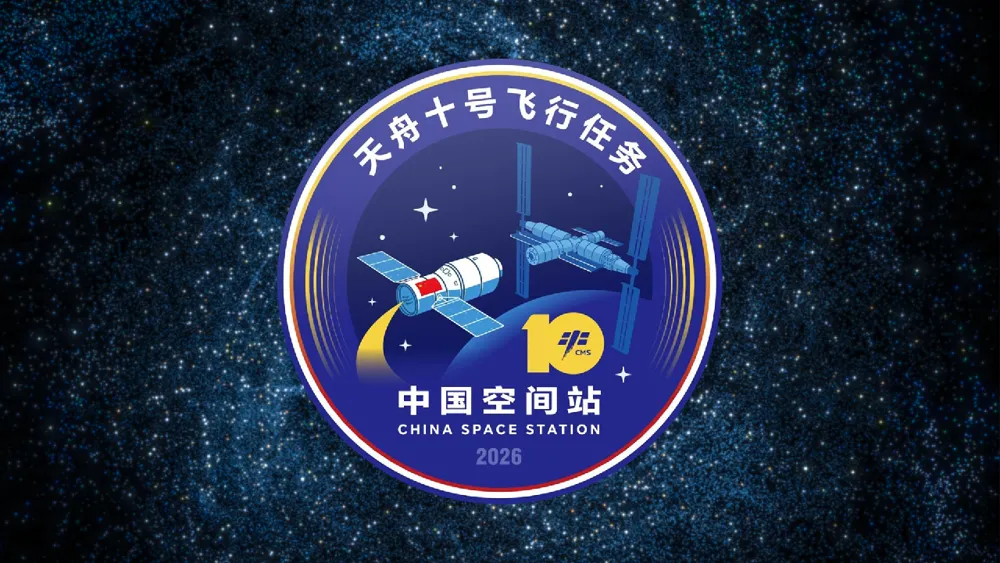
On Tuesday, the China Manned Space Agency (CMSA) unveiled the logo for the Tianzhou-10 cargo mission, a significant step in China's ongoing efforts towards enhancing international collaboration in space exploration. This mission is one of three planned flights to the Tiangong space station in 2026.
The newly revealed logo features a cosmos-blue background, with the Tianzhou cargo spacecraft prominently displayed in the center. This spacecraft follows a golden trajectory heading towards the Tiangong space station, complemented by a stylized numeral 10 integrated with the CMSA emblem, creating a visually captivating focal point.
CMSA explained that the circular design of the logo symbolizes aspirations for the mission's success and the pursuit of harmony between space and Earth. The gradient colors transitioning from gold to red further illustrate the bold spirit and courage of China's aerospace professionals.
This upcoming launch will represent the 10th mission of the Tianzhou-class uncrewed cargo spacecraft and the ninth resupply mission to the Tiangong space station. The previous mission, Tianzhou-9, was successfully launched on July 15, 2025.
The CMSA outlined that the Tianzhou-10 cargo spacecraft is scheduled for launch from the Wenchang Space Launch Site in 2026. It is designed to dock at the rear port of the core module of the Tiangong space station.
Tianzhou-10 is expected to deliver crucial crew supplies, maintenance spare parts, propellant, and new extravehicular activity (EVA) suits, according to reports from Xinhua. Additionally, its payload will include experimental samples for various applied science projects.
After completing its mission, the Tianzhou-10 spacecraft will deorbit and burn up in the atmosphere, effectively disposing of waste collected from the Tiangong space station.
In conjunction with the Tianzhou-10 mission, the CMSA has plans for two crewed missions to the Tiangong space station in 2026. This aligns with China's broader goals of advancing its human spaceflight capabilities.
Notably, crews from the Hong Kong and Macao Special Administrative Regions are expected to participate in future space station missions, starting as early as this year. A crew member from the Shenzhou 23 mission will be engaged in a one-year extended-duration experiment aboard the Tiangong space station.
This latest initiative emphasizes China's commitment to expanding its role in global space exploration and international collaboration, paving the way for shared advancements in this pioneering field.
Read These Next

Eye-Scanning Tech: Verifying Humanity in Digital Interactions
Exploring the introduction of eye-scanning technology by Tinder and Zoom for user verification and its implications in a digital world rife with AI impersonation.

Can a Digital Twin Create a 'Superworker'?
This article explores the potential of digital twins, like Richard Skellett's AI counterpart, to transform ordinary workers into 'superworkers' by enhancing their productivity and addressing key considerations around governance and ethical use.

Quantum Computing: Can Europe Lead the Tech Race?
An overview of the potential for Europe, particularly France, to lead in the quantum computing race, highlighting key players and their innovative approaches.