

Shenzhou-21 Crew Progresses Space Experiments During Mission
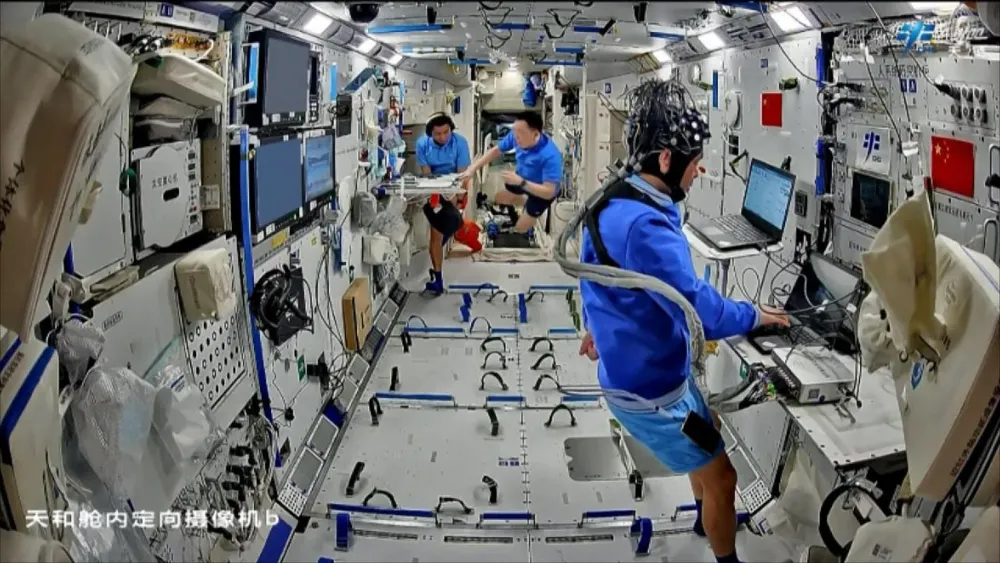
The crew of China's Shenzhou-21, astronauts Zhang Lu, Wu Fei, and Zhang Hongzhang, has spent over five months aboard the China Space Station, with mission tasks progressing steadily, according to the latest updates.
Over the past week, the crew carried out a series of scientific experiments and routine operations. In the field of space medicine, they conducted studies on trust and collaboration mechanisms, as well as human-machine interaction in space environments, using laptops and specialized software. They also performed experiments examining brain network activity in microgravity using near-infrared brain imaging equipment.
In microgravity physics, the astronauts carried out their scheduled tasks which included replacing ignition components and sampling covers in the combustion science experiment rack, swapping experiment samples in the fluid physics rack, and cleaning sample chambers as well as maintaining electrode systems in the containerless experiment facility.
For station management, the crew conducted environmental monitoring including measurements of temperature, airflow, and dew point. They also organized inventory, performed routine cleaning, and conducted inspections and maintenance of onboard equipment.
In terms of health maintenance, the astronauts underwent a variety of medical examinations, which included 12-lead electrocardiograms, non-invasive cardiac function assessments, and continuous ECG and blood pressure monitoring. They also utilized traditional Chinese medicine diagnostic tools to evaluate health indicators while adhering to regular exercise routines in orbit.
Read These Next

Eye-Scanning Tech: Verifying Humanity in Digital Interactions
Exploring the introduction of eye-scanning technology by Tinder and Zoom for user verification and its implications in a digital world rife with AI impersonation.

Can a Digital Twin Create a 'Superworker'?
This article explores the potential of digital twins, like Richard Skellett's AI counterpart, to transform ordinary workers into 'superworkers' by enhancing their productivity and addressing key considerations around governance and ethical use.

Quantum Computing: Can Europe Lead the Tech Race?
An overview of the potential for Europe, particularly France, to lead in the quantum computing race, highlighting key players and their innovative approaches.