

China's Super Lab Mimics Earth's Extremes for Scientific Breakthroughs
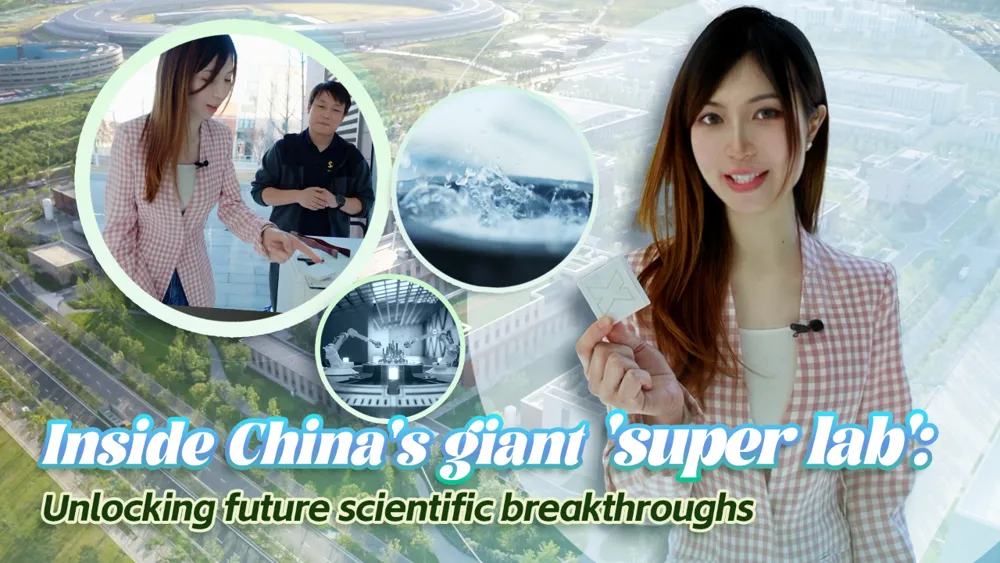
What possible breakthroughs occur when science dares to transcend the limits of Earth? The quest to understand the universe and its underlying principles has led researchers to explore environments and conditions far beyond the ordinary.
Step inside China's next-level giant super lab, where scientists are pushing the limits by recreating the most extreme conditions on Earth, from ultra-low temperatures to ultra-high pressures, all within one facility. This cutting-edge hub is established to facilitate groundbreaking research, unlocking innovations that could reshape technologies, medicine, and quantum computing.
The Synergetic Extreme Condition User Facility, located in Beijing's Huairou District, is a significant addition to global scientific research. It integrates sophisticated technologies designed to replicate extreme cosmic conditions, offering an unparalleled platform for scientific inquiry.
CGTN's Zheng Yuqiong provides an in-depth view of how this massive laboratory could significantly influence future scientific endeavors, positioning China as a prominent player in global science and technology advancement.
This facility is equipped with capabilities to reach ultra-low temperatures of just 1 millikelvin and to generate magnetic fields tens of thousands of times stronger than Earth's magnetic field. It stands as a testament to China's commitment to advancing research at the frontiers of science.
Moreover, the SECUF can simulate ultra-high pressures similar to those found at the Earth's core, facilitating experiments that investigate the unique behaviors of materials under conditions previously thought unattainable.
Experts anticipate that this facility will not only lead to the discovery of new superconducting materials, which are crucial for a range of technologies, but also potentially even room-temperature superconductors, a game-changing advancement in various fields.
As the international scientific community gathers at this ultra-modern lab, the newfound ability to conduct experiments across multiple extreme conditions is expected to drive significant advancements in material science, physics, and chemistry.
With 13 universities and research institutions from ten different countries already engaged with the facility, the SECUF is set to become a hub for collaboration, inviting global researchers to explore the mysteries of matter and unlock groundbreaking discoveries.
In conclusion, China's Super Lab represents a pivotal development in the realm of science and technology, potentially leading to breakthroughs that not only enhance our understanding of the material world but also have profound implications for technological advancement on a global scale.
Read These Next
China Boosts Healthcare with Expanded Medical Test Recognition
China's NHC initiates a 3-year plan to unify medical tests for better patient experience and resource optimization by 2027.

Ethics vs. Innovation: Anthropic and Pentagon's Standoff
The article discusses the tension between the U.S. Pentagon and Anthropic over the use of AI in military operations, emphasizing the ethical implications and the future of collaboration in AI technology.

Nvidia's Record Revenue Highlights AI Demand and Competition
This article explores Nvidia's record revenue growth amid a booming AI market, focusing on the distinctions between AI training and inference, and the broader implications for technology and competition.