

Space Mouse Welcomes First Generation of Pups for Research
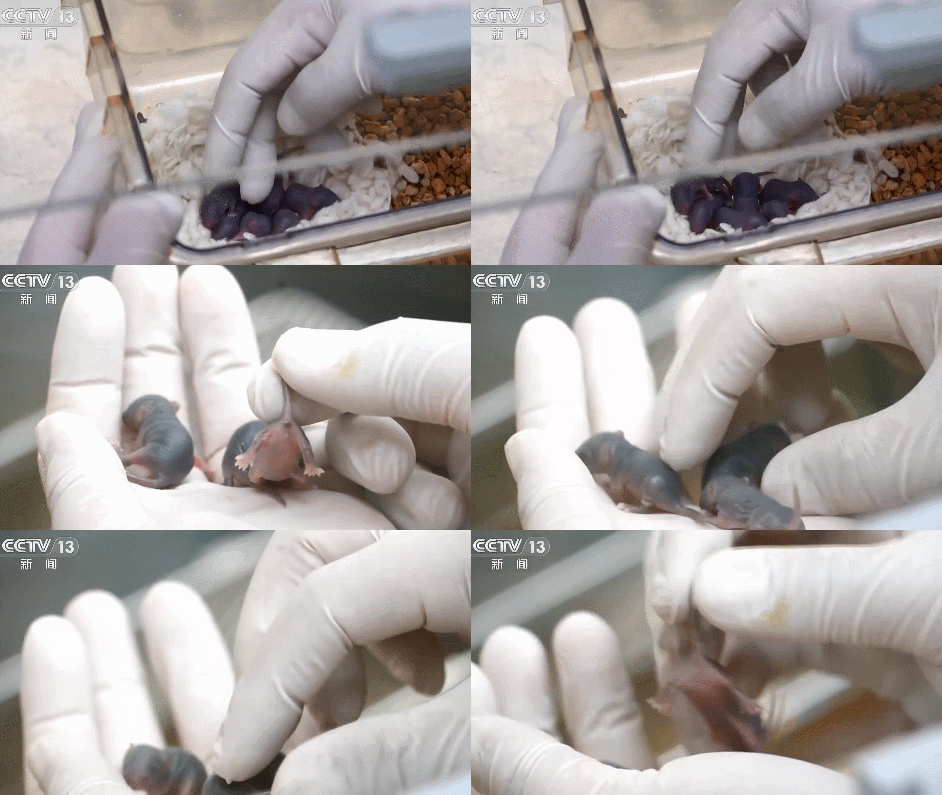
A female mouse from China's Shenzhou-21 spacecraft has successfully given birth to nine healthy pups, marking a significant advancement in understanding the effects of space travel on mammalian reproduction. This milestone was reported by the Technology and Engineering Center for Space Utilization at the Chinese Academy of Sciences.
The four mice embarked on their journey into space on October 31, participating in a carefully structured survival and adaptation experiment within the unique space environment. They were housed in a specialized habitat designed for small mammals aboard China's space station.
After returning to Earth on November 14, one of the female mice became pregnant and subsequently delivered nine pups on December 10. Out of these, six pups are alive and thriving, showcasing a normal survival rate.
Presently, researchers are closely monitoring these 'space mouse offspring,' with the mother displaying typical nurturing behaviors and the pups showing vibrant health and activity. This experiment demonstrates that short-term space flights do not adversely affect the reproductive capabilities of the mice.
Wang Hongmei, a researcher at the Institute of Zoology of the Chinese Academy of Sciences, noted that this mission provides invaluable samples for studying how the space environment influences early mammalian development.
However, the journey was not without challenges. Changes to the return plan for the Shenzhou-20 mission led to an unexpected food shortage for the mice. In light of this situation, the ground research team quickly implemented an emergency response plan.
To address the food shortage, the researchers collaborated with astronauts on the space station to facilitate an external water supply interface, allowing water to be pumped into the mice's habitat. This ensured the mice remained adequately hydrated.
The team identified several potential food substitutes from astronauts' supplies, including compressed biscuits, corn, hazelnuts, and soy milk. After conducting verification tests, soy milk emerged as the best option for emergency feeding.
By leveraging a pre-developed AI behavior analysis system, the research team monitored the mice's movements, eating habits, and sleep patterns in real time. This data significantly aided in predicting food consumption and enhancing decision-making during emergencies.
In the coming months, researchers will continue systematic studies on the mice pups, focusing on their growth, physiological changes, and potential reproductive capabilities. This long-term research aims to explore the implications of the space environment on multigenerational heredity and development in mammals.
Read These Next

SpaceX Rocket Failure Raises Pollution Concerns
This article explores the connection between space debris and atmospheric pollution, specifically highlighting the recent findings related to a SpaceX rocket failure and its environmental implications.

China to launch flagship science journal Vita in spring 2026
Vita, a new life sciences journal from Westlake University, launches in spring 2026 with global expert input and preprint sharing.

Climate Impact on Food Supply Becomes Global Emergency
Climate change is reshaping food production. The Hub hosts experts discussing extreme weather's impact on harvests and resilience.