

Blink-controlled wheelchairs enhance mobility for ALS patients
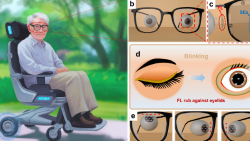
Groundbreaking new technology is enabling patients with amyotrophic lateral sclerosis (ALS) to control a wheelchair using only their eyes. This development marks a significant advancement in health technology, showcasing the potential of assistive devices to improve the quality of life for individuals with severe mobility impairments.
This cutting-edge innovation comes from a research team led by Professor Long Yunze at Qingdao University, in collaboration with partner institutions. The team has developed the world's first self-powered eye-tracking system that addresses a key power-supply bottleneck in traditional eye-tracking devices.
One of the biggest obstacles facing conventional eye-tracking systems is the power supply. Most commercially available devices rely on external power sources, making them bulky and inconvenient to use. For patients attempting to control a wheelchair with traditional eye-tracking equipment, heavy head-mounted devices, tangled power cables, and frequent low-battery warnings often create significant barriers to independent mobility.
To address this challenge, Professor Long's team proposed an innovative solution: generating power from the eyes themselves. This self-powered system allows users to control devices seamlessly through natural eye movements.
The newly developed system features a dual-layer design that merges components similar to contact lenses with a lightweight eyeglass frame. This innovation results in an ultra-light, highly wearable system that feels just like regular glasses. Most notably, all the electricity needed to operate the system is generated solely by eye movements.
According to Professor Long, the system operates like a "miniature power plant" embedded directly within the eye interface. A soft material known as polydimethylsiloxane (PDMS) adheres to the surface of the eyeball like a contact lens. Acting as a microscopic triboelectric generator, the PDMS continuously produces electric charges through friction whenever the user blinks or moves their eyes.
Meanwhile, glasses equipped with transparent indium tin oxide electrodes surrounding the lenses act as a signal transmission station. Through electrostatic induction, these electrodes sense alterations in charge distribution and convert them into electrical signals in real time, enabling precise control of external devices.
While promising, the technology still faces several challenges before it can be widely adopted. We are actively engaging with industry partners to explore collaboration opportunities and accelerate the commercialization process, said Zhang Jun, a core member of the research team.
If successfully scaled, this self-powered eye-tracking system could revolutionize the assistive technology landscape, offering patients greater independence, dignity, and control — all with a blink of one's eye.
Read These Next

Quantum Computing: Can Europe Win the Tech Race?
Exploring the potential of quantum computing in Europe, particularly through the lens of French companies like Alice & Bob, this article highlights the competitive landscape of the quantum technology sector and the unique advantages Europe possesses.

Chinese Team Introduces Smart Firewall Electrolyte for Battery Safety
A Chinese research team developed a non-flammable electrolyte for sodium-ion batteries that prevents thermal runaway, enhancing safety.

Amazon Ends Support for Older Kindles, Users Outraged
Amazon's decision to stop supporting older Kindle models has left many users frustrated and concerned about e-waste implications.