

Scientists Confirm Solid Inner Core Discovered on Mars
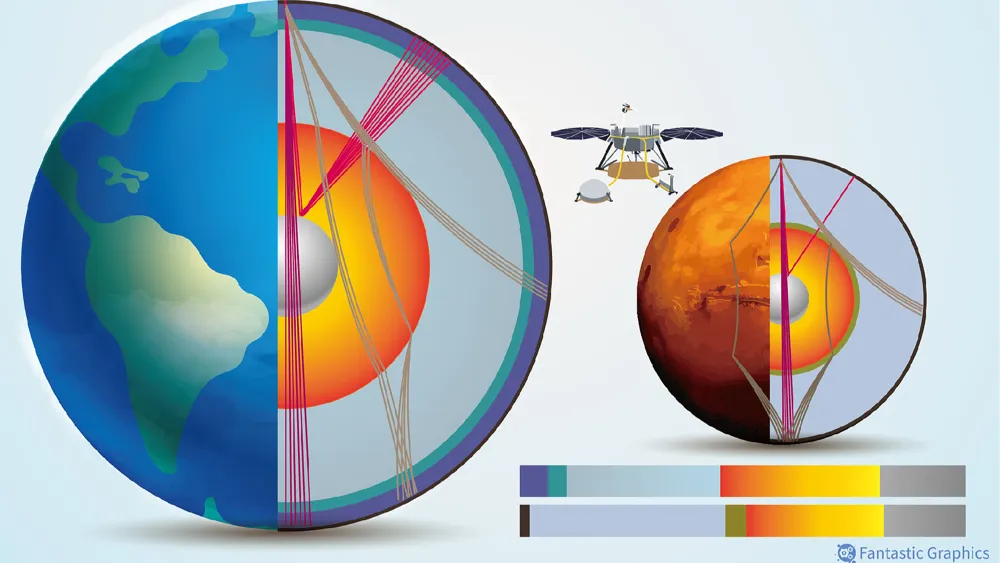
A breakthrough discovery by a team of Chinese and international scientists has confirmed the presence of a solid inner core on Mars. The core is primarily composed of iron, nickel, and lighter elements, mirroring the structural characteristics of Earth's core.
This groundbreaking finding stemmed from the meticulous analysis of seismic waves generated by marsquakes, which provide vital insights into the evolutionary history of Mars' magnetic field.
Leading the research were Sun Daoyuan and Mao Zhu from the University of Science and Technology of China in Anhui Province, who collaborated with international experts to analyze data recorded by NASA's InSight lander.
By employing advanced array analysis techniques on data derived from 23 marsquake events, the team successfully isolated key seismic phases that traversed Mars' core.
According to their paper published in Nature, the findings suggest that Mars' core exhibits a layered composition, consisting of a liquid outer core and a solid inner core with notably higher seismic wave velocities.
The solid inner core was measured to have a radius of approximately 600 kilometers, making up about one-fifth of the planet's total radius. If Mars were scaled to Earth's size, the relative proportions of its inner and outer cores would closely resemble those of Earth.
Furthermore, the analysis revealed a significant 30 percent increase in wave velocities and a 7 percent density difference between the outer and inner cores of Mars, leading the team to study the mineral composition of the inner core.
The analysis indicated that in addition to iron and nickel, Mars' core may also contain 12 to 16 percent sulfur, between 6.7 to 9 percent oxygen, and as much as 3.8 percent carbon.
Mars, being the terrestrial planet most comparable to Earth in terms of environment, has remained a focal point for scientists examining planetary internal structure and evolution, as well as a premier target for deep space exploration.
Exploring the inner structure of Mars, however, poses greater challenges than investigating Earth. While Earth’s inner core was inferred through seismic waves as early as 1936, confirming it as solid took nearly fifty years.
The research presents a pioneering study confirming a solid inner core on a planet beyond Earth, establishing that Mars possesses a core-mantle differentiation structure akin to that of our own planet.
This innovative utilization of Martian seismology not only enhances our understanding of Mars but also serves as a significant reference for future celestial exploration missions, like lunar expeditions, applying similar seismological methods to probe other celestial bodies.
Read These Next

Live The Hype Real Stories of Receiving Healthcare Abroad
'The Hype' roundtable explores evolving global travel and healthcare, focusing on traveler comfort and care through shared experiences.
China's Green Factory Initiative Aims to Decarbonize Manufacturing
China leads in green manufacturing transformation, prioritizing low-carbon systems in its 14th Five-Year Plan to cut emissions.
China Unveils Innovative Bone-Free Fish for Dinner Tables
Chinese scientists have created a bone-free Gibel carp, "Zhongke No. 6," enhancing aquaculture sustainability and culinary enjoyment.