

China launches two new satellites for Earth observation
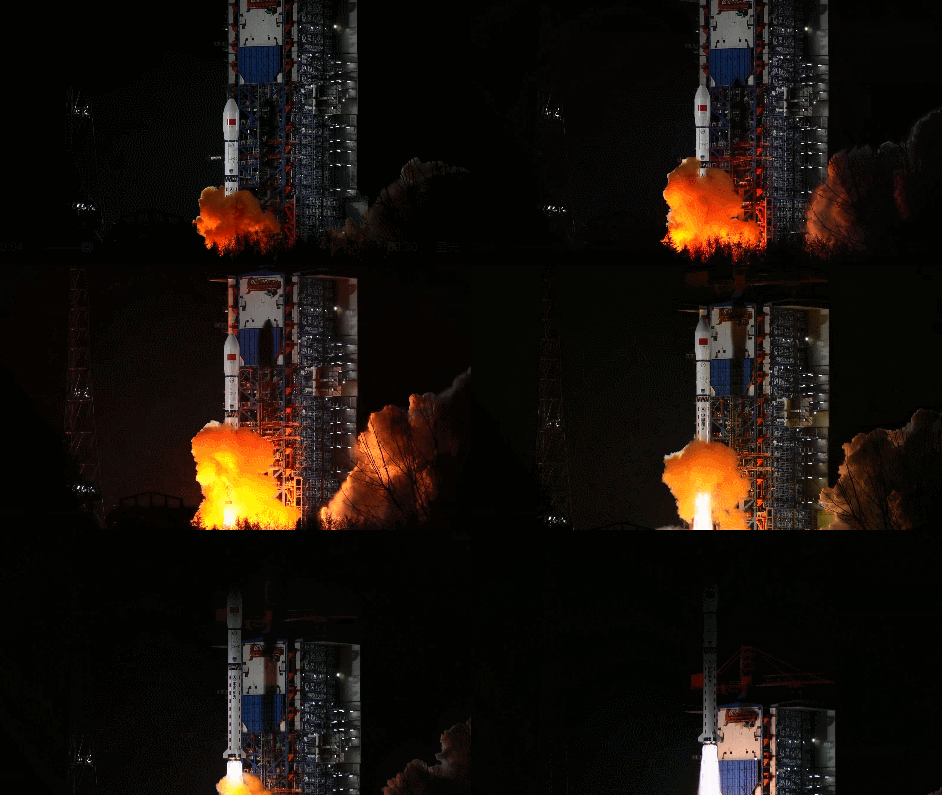
China has successfully launched two new test satellites, Shiyan-30 03 and 04, enhancing its capabilities in Earth observation technology. The launch took place at 6:33 a.m. from the Xichang Satellite Launch Center in the southwestern Sichuan Province, exemplifying China's continued commitment to advancing its space exploration initiatives.
The launch was conducted using the Long March-2D rocket, which is well-regarded for its reliability and efficiency in deploying payloads into orbit. The Shiyan-30 satellites were successfully placed into their designated orbits, a testament to the precision engineering involved in the mission.
Developed by the Shanghai Academy of Spaceflight Technology (SAST), these two satellites are geared towards the experimental verification of advanced Earth observation technologies. Such developments are crucial for enhancing the accuracy and efficiency of satellite data utilized for various applications including environmental monitoring, urban planning, and resource management.
The Long March-2D rocket, which executed the launch, is a two-stage carrier designed to handle liquid propellant. It features versatility in deploying both single and multiple satellites across different orbits.
Notably, the Long March-2D can send payloads of up to 1.3 tonnes into sun-synchronous orbits positioned at an altitude of approximately 700 kilometers. This capacity underscores China's growing proficiency in launching heavier and more complex satellite systems.
The weekend's launch marks the 632nd flight mission of the Long March carrier rocket series. This extensive history highlights China's advancements in space technology and its extensive experience in satellite deployment.
These recent developments in China's space exploration efforts are significant as they demonstrate the nation’s ability to enhance its scientific and technological infrastructure. By investing in Earth observation technologies, China aims to contribute to global efforts in monitoring climate change and natural disasters.
As the global landscape of space exploration evolves, China's initiatives reflect its strategic focus on scientific and technological growth. The successful launch of Shiyan-30 03 and 04 further solidifies the nation’s role as a major player in the field of satellite technology.
Read These Next

China's Brain-Computer Interface Tech Advances to Clinical Trials
BCI technology advances in China with stroke patients regaining limb control, highlighting its potential in neurology and a $13.86B market by 2035.
UNESCO Names Professor Chen Qun as Education Assistant Director-General
UNESCO has appointed Chinese Professor Chen Qun as assistant director-general for education to innovate global learning systems.

China Releases Guidelines for Global Sustainable Development Cooperation
The NSFC issued guidelines for the SDIC to tackle global issues and enhance international research collaboration.