

China's Space Mouse Welcomes Third Healthy Litter
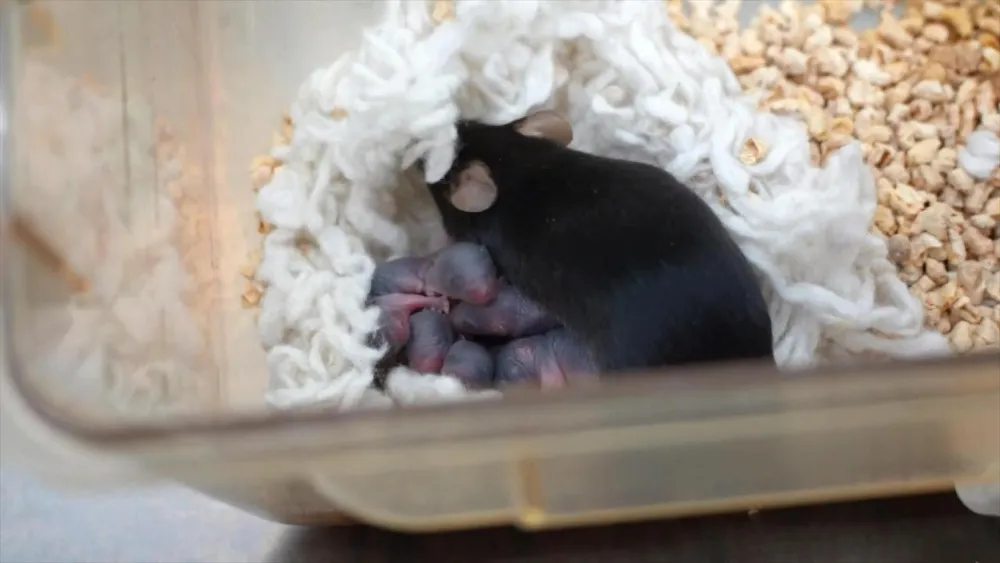
A mouse from the China Space Station has given birth to her third litter, aiding research on mammalian reproduction in space.
A female mouse that spent time aboard the China Space Station last year has given birth to her third consecutive healthy litter back on Earth, providing scientists with invaluable data on mammalian reproduction following spaceflight.
Four mice were sent to the space station as part of the Shenzhou-21 mission on October 31, 2025, marking China's first small-mammal experiment in orbit. The rodents spent approximately two weeks in a specialized habitat in microgravity conditions before returning to Earth on November 14.
Shortly after their return, one female gave birth to her first litter of nine pups on December 10. Since then, she has had two more healthy litters, consisting of 10 and nine pups, respectively. The size of each litter has surpassed the usual terrestrial litters, which typically contain five to seven pups, as reported by China Media Group.
Researchers at the Chinese Academy of Sciences' Institute of Zoology have noted interesting behavioral differences among the three litters.
The first exhibited more cautious, socially anxious behavior, frequently hiding in sheltered areas. The second showed greater confidence by exploring their environment more readily. By the third litter, the offspring demonstrated progressively improved adaptation to ground living conditions.
Overall, each successive litter has demonstrated a better adaptation to terrestrial living conditions compared to its predecessor. These subtle changes offer significant evidence for the research on reproduction in space environments.
Mice have approximately 85 percent genetic similarity to humans and have rapid reproductive cycles, making them ideal models for the study of potential risks to human reproduction during long-term space missions.
Researchers will closely monitor these space pups, tracking their growth curves and testing whether they can reproduce normally, while searching for potential generational impacts.
Looking ahead, the scientific team plans to conduct longer-duration space experiments with mice, similar to human orbital missions that last over six months, to study their physiological responses and spatial adaptability.
These findings bring scientists closer to answering a fundamental question for the future of humanity in space: can mammals successfully reproduce beyond Earth?
Read These Next

The deep sleep myth why your smartwatch isn't the final word on rest
Dr. Sun Wei highlights misconceptions about sleep tracking, urging focus on relaxation techniques and real-life impacts of sleep quality.

UNRWA Reports 391 Personnel Killed in Gaza Conflict 2023
UNRWA reports 391 personnel killed in Gaza since 2023, serving 67,000 displaced people amid ongoing humanitarian challenges.

Gwadar's Pak-China Friendship Hospital Transforms Lives Under CPEC
The Pak-China Friendship Hospital in Balochistan treated over 48,000 patients in early 2026, enhancing local healthcare access.