

Chinese Scientists Create World's First Ultra High Parallel Optical Chip
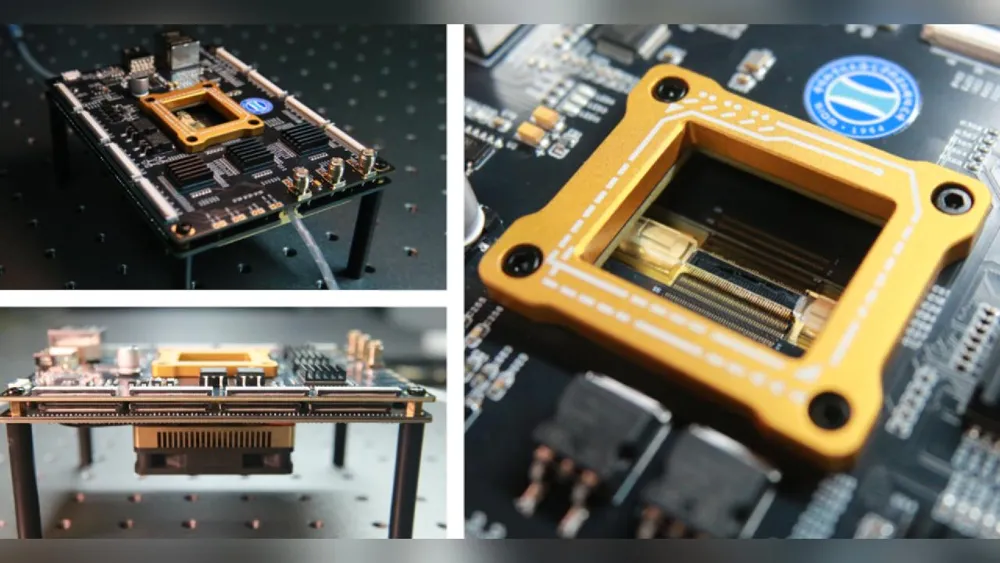
Chinese scientists have achieved a significant milestone in computing technology by developing the world's first ultra-high parallel optical computing integrated chip. This groundbreaking chip boasts a theoretical peak computing power of 2560 TOPS (Tera Operations Per Second) with an optical clock speed of 50 GHz, positioning it as a formidable competitor to NVIDIA's advanced GPU chips.
This remarkable achievement stems from the dedicated efforts of researchers at the Shanghai Institute of Optics and Fine Mechanics (SIOM), which operates under the auspices of the Chinese Academy of Sciences. Their innovative approach involved the introduction of a new ultra-high parallel photonic computing architecture.
The research team has succeeded in independently developing an optical computing chip that features expansive bandwidth, exceeding 40 nm, with properties that allow for low loss and reconfigurability. These enhancements play a crucial role in amplifying the chip's overall computing capabilities.
A pivotal aspect of their innovation is the employment of soliton microcomb sources, which facilitate over 100 wavelength channels. This advancement signifies a remarkable leap in optical computing technology.
"We've achieved information interaction and computation with over 100-wavelength multiplexing on an optical chip, demonstrating high-density on-chip information parallel processing," explained Xie Peng, a leading researcher at SIOM.
In contrast to traditional optical computing methods that depend on a single wavelength, this new ultra-parallel technique utilizes more than 100 distinct light wavelengths to simultaneously process multiple data streams. This methodology can boost computing power by up to 100 times without necessitating an increase in chip size or operational frequency, as indicated in their findings.
"It's like transforming a single-lane highway into a superhighway capable of handling a hundred vehicles simultaneously, greatly enhancing throughput per unit of time without the need for modifying the chip hardware," remarked Han Xilin, an engineer involved in the project.
The advantages of optical computing—characterized by high frequency, significant parallelism, and large bandwidth—present considerable potential for improving both computing density and performance through heightened parallelism. Such capabilities are particularly relevant in applications spanning artificial intelligence and data centers.
This parallel optical computing architecture holds promise for providing efficient solutions across various domains, including embodied intelligence, neural networks, physical simulations, and image processing. Additionally, the minimal latency that comes with photonic computing makes it especially suited for edge devices, which handle small data volumes but demand high-speed responses, such as in communication networks and drone swarms.
The team's pivotal findings were officially published on Tuesday, featured as the cover paper in the journal eLight, under the title "Parallel Optical Computing Capable of 100-Wavelength Multiplexing," marking a significant contribution to the field of optical computing.
Read These Next

China installs world's first 20 megawatt offshore wind turbine
China has installed the world's first 20MW offshore wind turbine, powering 44,000 homes in Fujian, boosting clean energy efforts.

Musk's SpaceX and xAI: Partnering for Space AI Future
Exploring the merger between Musk’s SpaceX and xAI, its implications in the realms of AI and space technology, and what this fusion means for future innovations.

Industrial Upgrading Fuels Environmental Protection for Beautiful China
China's 15th Five-Year Plan promotes a 'Beautiful China' through green industrial transformation and sustainable practices.