

China Showcases AI Computing Capabilities in Outer Space
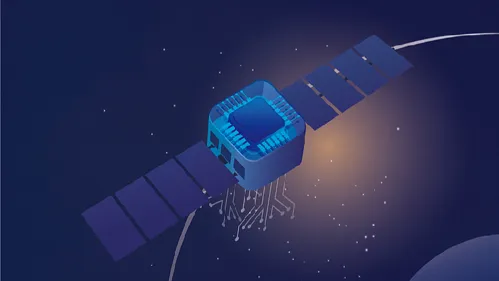
China has made a remarkable advancement in establishing an AI-driven space infrastructure by deploying a satellite constellation that successfully integrates 10 artificial intelligence models into orbit and develops inter-satellite networking capabilities.
This new deployment highlights significant applications of AI in crucial areas such as deep space exploration, smart city development, and natural resources surveying, as underscored by the Zhejiang Lab, which spearheaded the creation of the constellation in partnership with international collaborators.
In May 2025, China launched 12 satellites, which constitute the inaugural group of what is referred to as the 'Three-Body Computing Constellation', ushering in a new era of space-based computing.
After nearly nine months of rigorous in-orbit testing, the constellation has successfully illustrated its core capabilities, which include advanced networking, computing functions, model deployment, and the verification of scientific payloads.
Among the AI models utilized in this initiative are an 8-billion-parameter remote sensing model and an 8-billion-parameter astronomical time-domain model, both ranking among the most substantial parameter AI models currently operational in Earth’s orbit.
In November 2025, the remote sensing model was put to the test, conducting an infrastructure census over a 189 square kilometer area in northwest China, where it effectively identified stadiums and bridges, even amidst challenging weather conditions like heavy snow.
For astronomical research purposes, the constellation deployed two satellites equipped with cosmic X-ray polarization detectors. These satellites facilitated the rapid classification of gamma-ray bursts in orbit, achieving an impressive accuracy rate of 99 percent while significantly enhancing data transmission and processing efficiency.
The team also successfully established inter-satellite communication links among six of the deployed satellites, marking a pivotal step forward in creating a functional space networking framework.
Upon completion of its planned deployment of over 1,000 satellites, the constellation is projected to perform a staggering 100 quintillion operations per second, demonstrating its vast computing potential as reported by the lab.
"With a computing constellation in place, a portion of the data can be processed directly in space and delivered seamlessly to users," remarked Li Chao from Zhejiang Lab, highlighting the transformative impact of this initiative.
(Cover via VCG)
Read These Next

Eye-Scanning Tech: Verifying Humanity in Digital Interactions
Exploring the introduction of eye-scanning technology by Tinder and Zoom for user verification and its implications in a digital world rife with AI impersonation.

Can a Digital Twin Create a 'Superworker'?
This article explores the potential of digital twins, like Richard Skellett's AI counterpart, to transform ordinary workers into 'superworkers' by enhancing their productivity and addressing key considerations around governance and ethical use.

Quantum Computing: Can Europe Lead the Tech Race?
An overview of the potential for Europe, particularly France, to lead in the quantum computing race, highlighting key players and their innovative approaches.