

Chinese Researchers Achieve Breakthrough in Storage Density
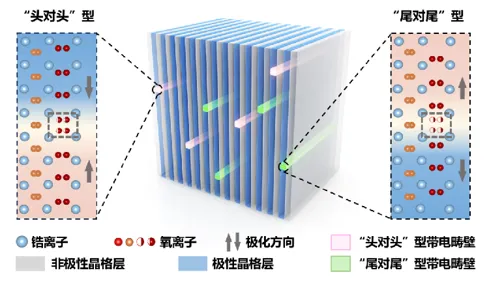
Chinese researchers have achieved a significant breakthrough in the field of ferroelectric materials, poised to dramatically enhance information storage density. This groundbreaking research was published in the journal Science on Friday.
The research team, hailing from the Institute of Physics at the Chinese Academy of Sciences, successfully identified one-dimensional charged domain walls within a specially structured ferroelectric material.
These domain walls are remarkably thin, with both thickness and width measuring merely a few hundred-thousandths of the diameter of a human hair. This discovery establishes a robust scientific foundation for the upcoming development of ultra-high-density devices.
Ferroelectric materials hold tremendous potential for future technological advancements, especially in critical areas such as data storage, sensing, and artificial intelligence applications.
Storing information within these one-dimensional domain walls could result in an unprecedented increase in storage density, potentially augmenting it by several hundred times.
The theoretical storage limit has been estimated at around 20 terabytes per square centimeter, providing enough capacity to accommodate 10,000 high-definition movies or 200,000 high-definition short videos within a device no larger than a postage stamp.
Read These Next

Eye-Scanning Tech: Verifying Humanity in Digital Interactions
Exploring the introduction of eye-scanning technology by Tinder and Zoom for user verification and its implications in a digital world rife with AI impersonation.

Can a Digital Twin Create a 'Superworker'?
This article explores the potential of digital twins, like Richard Skellett's AI counterpart, to transform ordinary workers into 'superworkers' by enhancing their productivity and addressing key considerations around governance and ethical use.
Quantum Computing: Can Europe Lead the Tech Race?
An overview of the potential for Europe, particularly France, to lead in the quantum computing race, highlighting key players and their innovative approaches.